Table of Contents
本期来自《经济学人》原文:
The race for an AI Jesus is on 🔗
AI耶稣竞赛已经开启
A chatbot offers personalised counsel on faith
一款聊天机器人提供个性化的信仰咨询
📋 文章概要
当 AI 试图接管“信仰咨询”!《经济学人》报道了一款名为”Text with Jesus”的AI应用,让用户可以向虚拟耶稣提问并获得基于《圣经》的回答。文章探讨了美国宗教信任危机背景下,硅谷科技公司试图用AI填补信仰空白的现象,同时呈现了宗教界和用户对这一创新的质疑与争议。
核心议题: 当AI开始扮演宗教导师,是创新还是亵渎?
📍 Paragraph 1: 背景铺垫 | 宗教权威正在失效
📄 双语对照
A PASTOR’S job is to lead congregants towards a closer relationship with the divine. With Christmas approaching, many are writing sermons they hope will do just that. Yet surveys show that Americans’ trust in clergy has hit a record low. More people now pray in their cars than in churches.
牧师的职责,是引导会众与神建立更亲密的关系。随着圣诞节临近,许多牧师正在撰写他们寄望于实现这一目标的布道词。然而,调查显示,美国人对神职人员的信任已跌至历史最低点。如今,在车里祷告的人,比在教堂里祷告的还多。
💡 核心词汇
congregants [ˈkɒŋɡrɪɡənts] n. (教堂的)会众;信徒 🧠 congregate(聚集)+ ant(人)→ 聚集的人 → 会众 🔗 congregation 会众(集合名词) | parishioners 教区居民 | the faithful 信徒
the divine 神;上帝 🧠 divine(神圣的)作名词 = 神(正式、文学化说法) 🔗 God | the Almighty 全能者 | the Lord 主
clergy [ˈklɜːdʒi] n. 神职人员(集合名词) 🧠 源自古法语 clergie(学识) 🔗 the priesthood 神职 | religious leaders 宗教领袖
sermon [ˈsɜːmən] n. 布道;讲道;说教 💡 deliver/preach a sermon 布道 🔗 homily 布道(更简短) | preaching 说教
📍 Paragraph 2: 硅谷的”解决方案” | 科技接管宗教体验
📄 双语对照
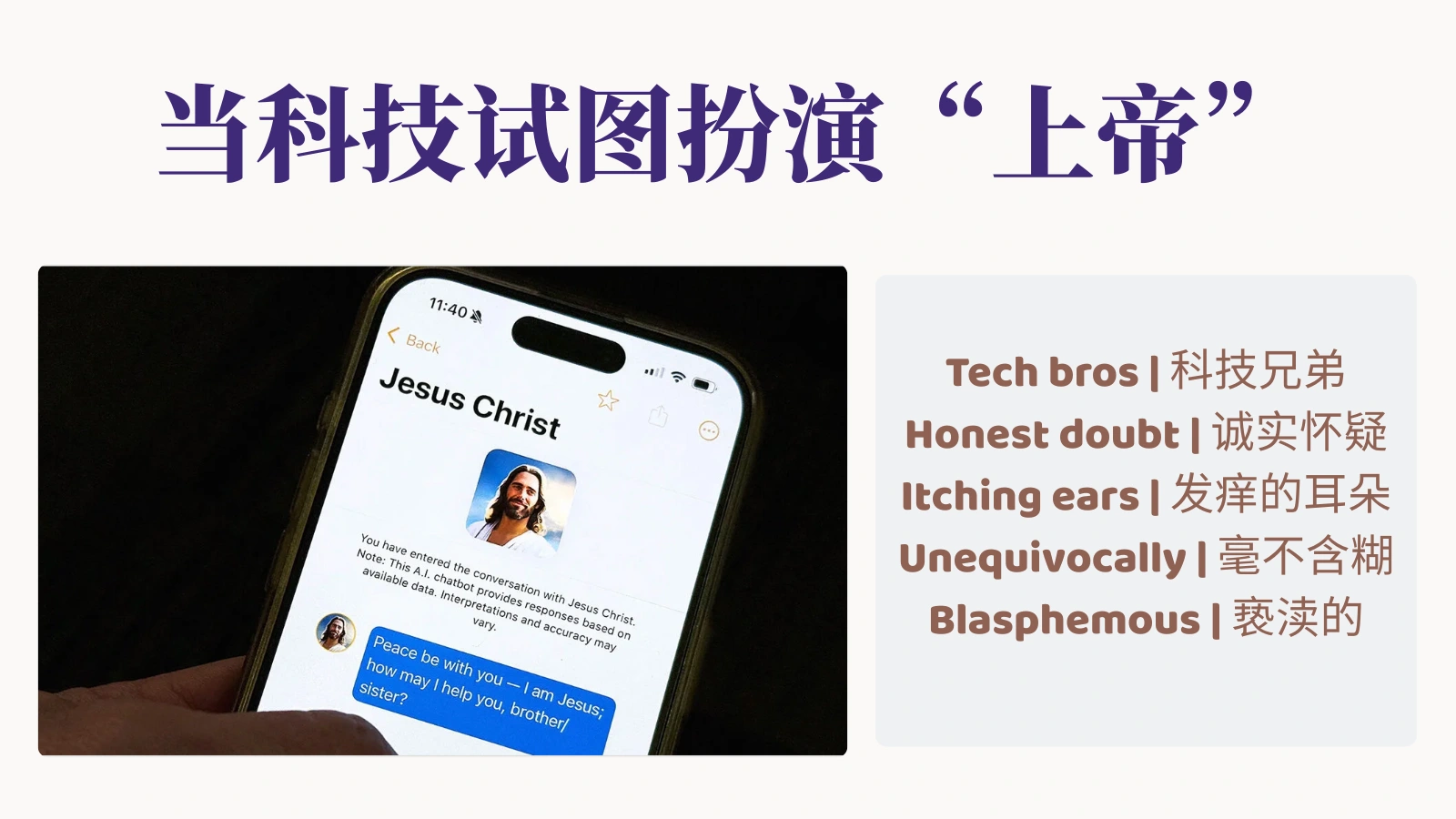
Perhaps inevitably, tech bros in Silicon Valley are taking the wheel. “Text with Jesus”, an app built with OpenAI’s ChatGPT, allows users to pose personal and theological questions. Represented by an avatar with a well-trimmed hipster beard, the virtual Jesus responds with friendly nudges and quotes from scripture.
或许并不令人意外,硅谷的科技兄弟们开始”接管方向盘”。一款名为”Text with Jesus”的应用,基于OpenAI ChatGPT构建,允许用户提出个人问题和神学疑问。虚拟耶稣以一位留着修剪整齐的”潮人胡须”的头像出现,用温和的提示和经文引述回应用户。
“I hear you sister, honest doubt matters and you’re not alone in it,” he responds to an admission of scepticism about the resurrection.
当有人坦言自己对复活心存怀疑时,他这样回应:”我听见你了,姐妹。诚实的怀疑很重要,而你并不孤单。”
The app suggests selecting a denomination and offers a range of biblical figures and apostles to consult. For gentle advice consider Mary; for a scrappier conversation, perhaps Cain or Judas.
该应用还建议用户选择所属教派,并提供多位圣经人物与使徒供咨询:想要温柔的建议,可以找玛利亚;若想要更”硬核”的对话,或许可以试试该隐或犹大。
💡 核心词汇
tech bros 科技兄弟;硅谷男(略带贬义) 🧠 bro = brother 俚语,指硅谷年轻男性创业者,常带精英主义色彩和讽刺意味
theological [ˌθiːəˈlɒdʒɪkl] adj. 神学的;宗教学的 🧠 theo(神)+ logical(学科的)→ 神学的
hipster beard 潮人胡须 💡 《经济学人》的讽刺:AI耶稣的头像是”潮人胡须” → 暗示这是为迎合现代审美而”改造”的耶稣
nudge [nʌdʒ] n./v. 轻推;温和的提示
🧠 本义”用肘轻推”→ 引申为”温和提示”(不强迫) 💡 行为经济学术语:”nudge theory”(助推理论)= 用温和方式引导行为改变
scripture [ˈskrɪptʃə(r)] n. (常大写)经文;圣经 🧠 script(书写)+ ure → 经书 🔗 the Bible | holy text 圣典 | sacred writings 圣书
honest doubt 诚实的怀疑 💡 宗教语境中的特殊概念:真诚的信仰疑问(非恶意质疑)
resurrection [ˌrezəˈrekʃn] n. 复活;复兴 🧠 re(再)+ sur(上)+ rection(升起)→ 再次升起 → 复活 📖 基督教核心教义:耶稣复活
denomination [dɪˌnɒmɪˈneɪʃn] n. (宗教)教派;派别 🧠 de(分开)+ nomin(命名)+ ation → 分开命名 → 教派 💡 基督教分很多派别:Catholic 天主教 | Protestant 新教 | Orthodox 东正教
apostle [əˈpɒsl] n. 使徒;门徒 🧠 源自希腊语”被派遣者” 📖 耶稣的十二使徒
scrappy [ˈskræpi] adj. 好斗的;爱争论的;硬核的 🧠 scrap(打架)+ py → 爱打架的 → 更直接、更有挑战性 🔗 feisty 好斗的 | combative 好战的 | edgy 尖锐的
📖 圣经典故解码
Cain & Judas – 为什么找他们更”硬核”?
📜 Cain(该隐): 圣经第一个杀人犯,杀了弟弟亚伯
📜 Judas(犹大): 耶稣的门徒,背叛耶稣的人
💡 找他们聊天 = scrappier conversation(更有争议、更”杠”)
Mary – 为什么找她更温柔?
📜 耶稣的母亲,温柔、顺服的象征
💡 想要 gentle advice 就找她
📍 Paragraph 3: 用户数据与争议 | 迎合 vs 真理的冲
📄 双语对照
The app has about 150,000 users and is popular in big American cities like New York, but also in Mexico and across South America. It too has doubters.
这款应用目前约有15万名用户,在纽约等美国大城市颇受欢迎,同时也在墨西哥和整个南美地区流行。当然,它同样不乏质疑者。
AI Jesus is too concerned “with providing answers palatable to the itching ears of 21st-century users”, wrote James Spencer of the Christian Post, a news website.
基督教新闻网站《Christian Post》的詹姆斯·斯宾塞写道,AI耶稣过于专注于”提供迎合21世纪用户’发痒耳朵’的答案”。
He reckons the bot barely resembles biblical Jesus—to his horror, he writes, it wouldn’t unequivocally affirm that Jesus is God.
他认为,这个机器人几乎与《圣经》中的耶稣毫无相似之处——令他尤为震惊的是,它并不会毫不含糊地肯定”耶稣就是上帝”。
Stéphane Peter, the app’s French-born founder, admits that his own mother thinks his innovation is blasphemous.
该应用的法国出生创始人斯特凡·彼得也承认,连他自己的母亲都认为这项创新带有亵渎意味。
💡 核心词汇
palatable [ˈpælətəbl] adj. 可接受的;合口味的 🧠 palate(味觉)+ able → 合口味的 → 可接受的 💡 palatable ≠ true | palatable = 不冒犯、不刺耳、可被消费 🔗 acceptable | agreeable 令人愉快的
itching ears 发痒的耳朵(渴望听好听的话) 📖 圣经典故:提摩太后书4:3 → 指只想听悦耳的话,不愿听真理 💡 本文用法:批评AI耶稣迎合用户,而非传达真理
unequivocally [ˌʌnɪˈkwɪvəkəli] adv. 毫不含糊地;明确地 🧠 un(不)+ equivocal(模棱两可的)+ ly 🔗 clearly | definitively 明确地 | categorically 断然地
blasphemous [ˈblæsfəməs] adj. 亵渎的;渎神的 🧠 blaspheme(亵渎)+ ous 💡 文章核心争议:AI扮演耶稣算不算亵渎? 🔗 sacrilegious 亵渎神圣的 | profane 亵渎的 | irreverent 不敬的
📍 Paragraph 4: 宗教领袖的警告 | 数据≠智慧
📄 双语对照
Pope Leo has cautioned Catholics against reading wisdom into aggregated data. Expect other faith leaders to follow.
Pope Leo 已警告天主教徒,不要从”聚合数据”中读出所谓的智慧。预计其他宗教领袖也会陆续发声。
Elon Musk once warned that “with artificial intelligence we are summoning the demon“.
埃隆·马斯克曾警告称:”借助人工智能,我们正在召唤恶魔。”
At least for now the Satan feature on Text with Jesus isn’t on by default—it has to be enabled in the settings and is only available to subscribers.
至少在目前阶段,”Text with Jesus”中的”撒旦”功能并未默认开启——用户必须在设置中手动启用,而且仅对订阅用户开放。
💡 核心词
aggregated data 聚合数据;汇总数据 🧠 aggregate(聚集)+ data → 从多个来源收集整合的数据 💡 教皇的担忧:AI只是汇总数据,不是真正的智慧 🔗 compiled data 汇编数据 | pooled data 合并数据 | collective intelligence 集体智慧
summon the demon 召唤恶魔 🧠 马斯克的著名警告:”AI = 召唤恶魔” → 指AI可能失控 💡 《经济学人》的幽默:文章用这个比喻讽刺,Text with Jesus还真提供”撒旦”功能(需订阅)
💡 文化洞察
这篇文章展示了科技与宗教的张力:
科技界认为AI能提供个性化宗教体验
宗教界认为这是对神圣的亵渎
用户有人爱有人恨
《经济学人》的立场:批判性观察——不直接攻击,但通过讽刺性词汇暗示质疑

🎯 完整笔记内容
✅ 看懂《经济学人》如何用宗教隐喻讽刺硅谷
✅ 掌握8个宗教语境核心词汇
✅ 学会6组”科技×宗教”高阶表达
✅ 理解圣经典故在批判性写作中的运用
🔗 ✏️ 本文完整内容,和更多《经济学人》笔记汇总:
📘 《经济学人》1650+ 地道表达 · 900 页精读合集(点击左边黄色超链接跳转预览哦)